POS-sible
Other POS software records what happened. POS-sible shows shop owners what is possible next.
- Client
- In-house product
- Scope
- Product, design, engineering
- Platform
- Web app and Postgres API
- Languages
- English and Bangla
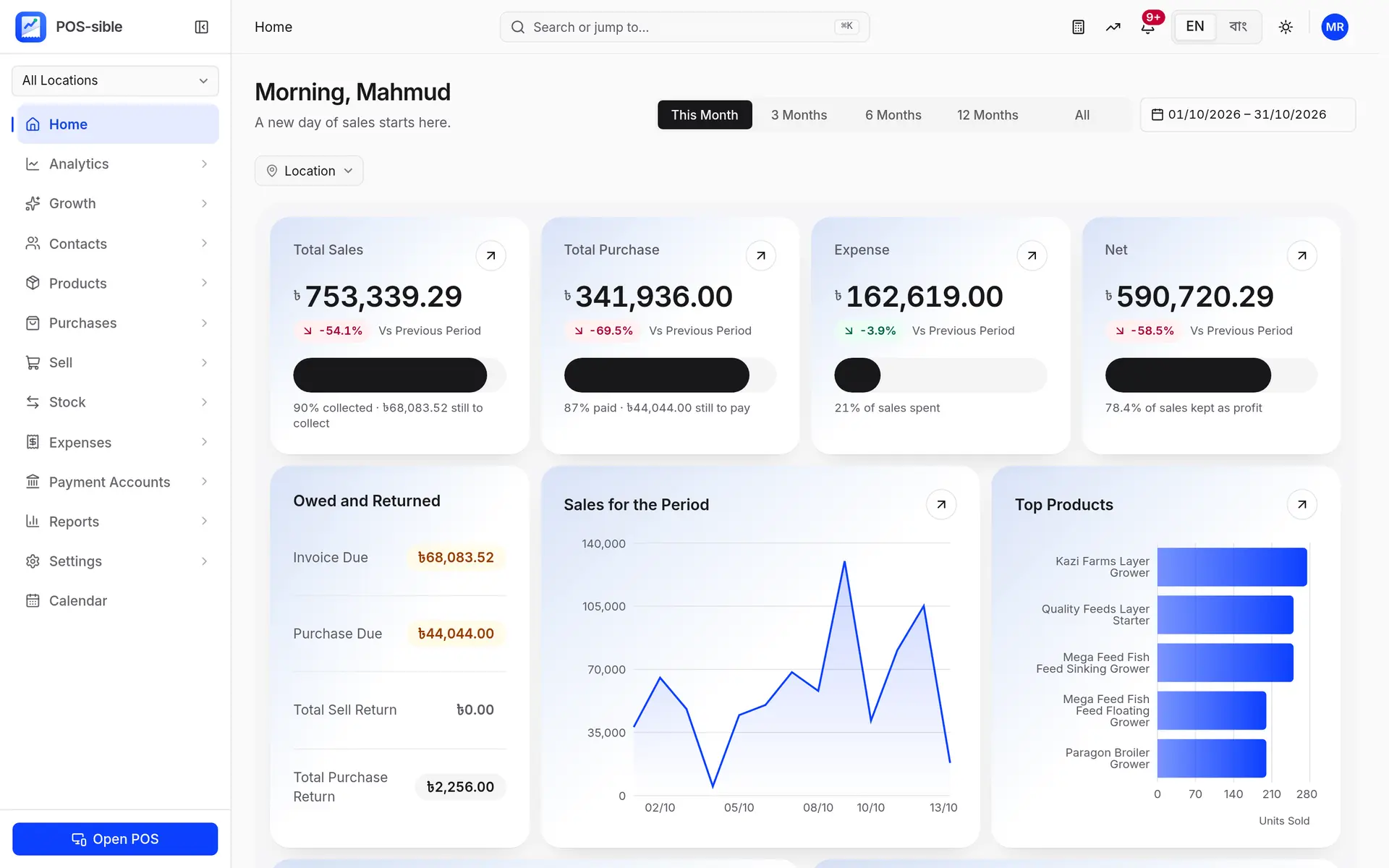
Shops record everything and still guess
A typical retail shop already logs every sale, purchase and expense. The software stops there. The owner still has to work out which product will run out this week, which regulars have gone quiet, and whether the month will hit target.
Owners in Bangladesh also need things most POS tools treat as an afterthought: Bangla throughout, mobile wallets at the till, and phone numbers that open straight into a call or WhatsApp.
Turn the data shops already have into a next step
We wanted a point of sale that does the bookkeeping well and then reads it back to the owner in plain English or Bangla: restock this fast seller before it runs out, win back these customers, add this much a day to reach the goal.
Every figure comes from the shop's own transactions, so the advice is specific and checkable. The name is the promise: more than a POS, it shows what is possible.
Made for how local shops actually sell
We designed around the counter, not a spreadsheet. Three things most POS tools treat as an afterthought sit at the center of POS-sible.
Bangla throughout
Every screen, receipt and report works in Bangla as well as English, not as a translated afterthought.
Mobile wallets at the till
bKash, Nagad, Rocket and Upay sit next to cash and card, among nine payment methods, with split payments.
Customers one tap away
Phone numbers open straight into a call or WhatsApp, because that is how shops actually follow up.
A full retail back office with a growth layer on top
Everything a shop needs to run day to day, and one layer most POS tools never get to: what to do next.
Selling
A fast register with barcode scanning, variations, serial and IMEI tracking, split payments, suspend and resume, quotations, credit sales, and thermal or A4 receipts.
Back office
Catalog, stock per location with FIFO or LIFO costing, transfers, purchases and returns, expenses, and double-entry accounts that reconcile with stock.
Growth layer
An Opportunities inbox ranks the next best moves by the money each could bring. Goals forecast where the month will land and say how much more a day closes the gap.
Teams and platform
Staff sign-in, a role permission matrix, audit stamps on every record, and an owner console for subscriptions, packages and revenue across fully isolated businesses.
Try it before you trust it
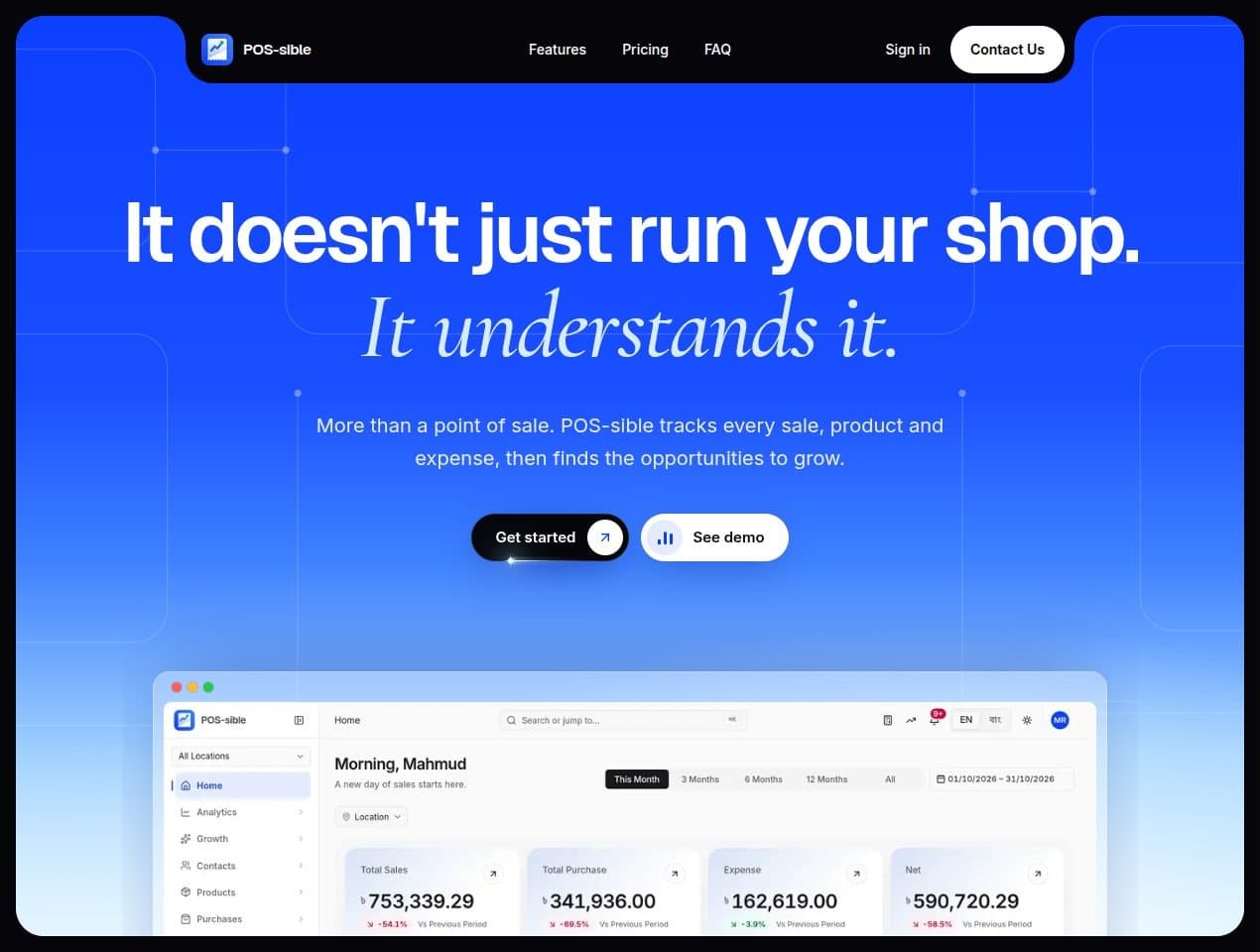
The landing page makes the promise in one line, and the demo mode backs it up: the whole app runs in the browser with generated data, so an owner can ring up a sale and read the Opportunities inbox before anyone sets up a server.
Decisions that kept it fast to ship and safe to run
One codebase, two modes
The same app runs as a browser-only demo with generated data, or in API mode backed by Postgres. Sales demos need no server, and real shops get a real backend.
Rules live on the server
Screens talk to services. In API mode those services run on the server, so permissions and business rules hold no matter which screen calls them.
Accountability in one place
Created by, created at, updated by and updated at are written automatically on every record, so no screen can forget or forge them.
First-party sessions
The web app proxies /api to the backend, so session cookies stay first-party and the browser only ever talks to one origin.
Stack
- Next.js 16
- React 19
- TypeScript
- Tailwind CSS
- shadcn/ui
- TanStack
- next-intl
- Highcharts
- PostgreSQL
- Playwright
- Vercel
- Coolify
By the numbers
- Route pages live
- 87
- Sub-projects shipped
- 8 of 8
- Payment methods at the till, including bKash and Nagad
- 9
- Modes from one codebase: browser demo and Postgres API
- 2
More case studies are on the way
We add new write-ups as projects ship.